
Views: 0 Author: Site Editor Publish Time: 2026-05-24 Origin: Site


While passenger vehicles often use simple hydraulic lines and mechanical cables, commercial and heavy-duty vehicles rely on highly sophisticated pneumatic or hydraulic networks. Within these complex systems, the foot brake valve (often called a treadle valve) and the hand brake valve serve distinctly different safety and compliance roles. Misunderstanding the mechanical routing, application limits, and wear patterns of these valves creates severe problems. It routinely leads to premature component failure, serious driver safety risks like trailer jackknifing, and costly fleet compliance violations.
This guide breaks down the physical differences, dynamic physics, and procurement considerations for both valve types. You will learn how to accurately evaluate replacement components and troubleshoot common system failures. Fleet managers, technicians, and owner-operators can use these insights to maintain optimal braking performance, ensure regulatory compliance, and keep drivers safe on the road.
Primary vs. Secondary Actuation: The foot brake valve acts as the system’s central hub, distributing proportional stopping power across all axles, whereas the hand brake valve acts as an independent override, typically isolating the trailer or rear wheels.
Dynamic Physics: Foot valves induce full-vehicle weight transfer; hand valves break rear traction or hold static weight without altering front-end suspension dynamics.
Safety Limitations: Hand brake valves are strictly for static holding, coupling tests, or extreme emergencies—they must never be used for downhill speed modulation.
Fail-Safe Integration: Both systems integrate with air reservoirs differently; heavy-duty air systems default to a locked state (fail-safe) if system pressure drops below critical thresholds (typically 60 psi).
Understanding heavy-duty braking requires separating primary system hubs from secondary actuators. The central Foot Brake Valve functions as the system's absolute core. It acts as the primary control center for all dynamic braking events. When you press the pedal, it converts your mechanical foot pressure into a proportional pneumatic or hydraulic signal. This valve does not simply dump air into the chambers. Instead, it meticulously controls pressure distribution across multiple braking circuits. In light vehicles, you might see a standard 75% front to 25% rear bias. In commercial tractor-trailers, this distribution becomes highly complex, spreading proportional force across multiple tractor and trailer axles to ensure smooth deceleration.
Conversely, the Hand Brake Valve functions as a dedicated branch or actuator. It serves a targeted, highly independent function. Most commonly, it controls only the trailer brakes or the rear-axle parking chambers. This component operates on an entirely distinct mechanical logic from the foot pedal. In commercial air systems, it typically utilizes a "pull to exhaust (park), push to supply (release)" mechanism. By operating independently of the primary fluid and air distribution network, it provides vital redundant security. If the main pneumatic hub fails, this independent actuator remains ready to isolate the trailer or secure the vehicle.
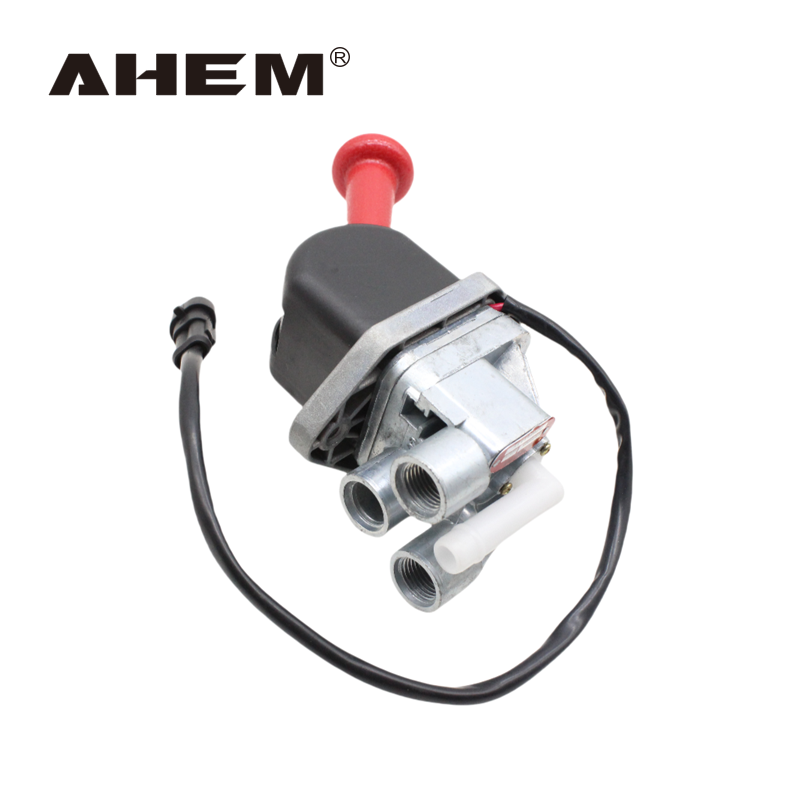
The internal engineering of these two valves reflects their operational roles. When you open up a foot valve, you find extreme internal component complexity. The architecture features multi-piston configurations, primary and secondary delivery ports, internal diaphragms, and heavy-duty return springs. These components must work in perfect harmony to regulate precise air volume based on minute pedal movements. Interestingly, in full air systems, the foot valve lacks the hydraulic "pushback" resistance found in passenger cars. Drivers must rely entirely on physical deceleration cues and pressure gauges, as the pedal feedback comes only from a mechanical return spring.
Hand valve internals are relatively simple. They usually consist of a single sliding spool or a plunger mechanism. The design carries a binary focus: it either opens a circuit to the atmosphere to exhaust air, or it connects the circuit directly to the air reservoir to supply pressure. It rarely handles the nuanced proportioning required by dynamic traffic stops.
System integration also differs significantly. The foot valve connects directly to both the primary and secondary air tanks. Engineers fully integrate it with modern ABS modules and proportioning valves to prevent wheel lockup during aggressive braking. The hand valve bypasses this complex modulation. It routes its air supply through double check valves. This critical routing ensures air only flows to the intended chambers, such as the trailer brakes, without backfeeding into the tractor's primary pneumatic system.
Feature | Foot Brake Valve (Treadle) | Hand Brake Valve |
|---|---|---|
Internal Complexity | High (Multi-piston, diaphragms, dual-ports) | Low (Sliding spool, single plunger) |
System Integration | Primary & Secondary tanks, ABS modules | Isolated branch via double check valves |
Driver Feedback | Spring-based resistance (relies on vehicle cues) | Mechanical detent (Push/Pull tactile click) |
Pressure Output | Proportional and variable | Usually full pressure or full exhaust |
Braking fundamentally alters how a vehicle interacts with the road. Applying the foot brake initiates a full-vehicle weight transfer. As you apply pressure to the treadle, the mass of the vehicle dynamically shifts forward. This physical action increases front-wheel traction, which directly aids your steering authority. Simultaneously, it reduces the load on the rear wheels. Because it carefully proportions pressure, this application is the only appropriate method for dynamic speed reduction, everyday traffic stops, and downhill momentum management.
Applying the hand brake triggers an entirely different physical response. It induces sudden, localized braking without gradual weight transfer. In limit-handling scenarios, such as motorsport or advanced driving simulations, drivers use it explicitly to break rear traction. Snapping the hand control locks the rear, inducing oversteer to navigate exceptionally tight turns.
However, in commercial applications, such extreme dynamic maneuvers are disastrous. Fleet operators must restrict hand brake application strictly to static holding, preventing rollback on steep inclines, and conducting trailer coupling tests (often called "tug tests"). Industry safety experts issue a severe warning: you must never use hand valves to slow down on a grade or to attempt to correct a jackknife. Locking the trailer wheels mid-motion removes their lateral grip entirely. When trailer wheels stop spinning, they simply slide, completely eliminating the driver's ability to maintain a straight trajectory.
Braking Action | Suspension Impact | Traction Result | Approved Scenario |
|---|---|---|---|
Foot Pedal Application | Mass shifts to front axles | Increases steering grip; prevents lockups | Downhill grades, traffic, normal stops |
Hand Control Application | No dynamic front weight shift | Breaks rear/trailer lateral grip | Coupling tug tests, static incline holds |
Maintaining these systems requires precise diagnostic protocols. Diagnosis and troubleshooting criteria vary heavily between the two components. Foot valves frequently suffer from environmental exposure. They are prone to corrosion in the treadle hinge, which can cause the pedal to stick. Internally, leaking diaphragms result in a "spongy" response or delayed air delivery. Fleet operators should routinely check that the delivery pressure perfectly matches the pedal travel. A lag in this ratio indicates failing internal springs or blocked primary ports.
Hand valve failures present differently. The most common issues involve internal seal degradation. When O-rings fail, they create slow air leaks, often identifiable by a distinct hissing sound inside the cab. Another major vulnerability lies in the external double check valve. If this check valve fails, it causes a delayed release, holding the trailer brakes in a locked position long after the driver pushes the dash valve in.
Misuse aggressively accelerates system wear. Riding the hand valve during transit to subtly slow down severely overheats the rear drums and rotors. This intense heat glazes the brake shoes, destroying their friction coefficient and drastically accelerating component wear.
Ultimately, both valves remain inextricably tied to the vehicle's fail-safe system. Maintenance schedules must prioritize air retention. Technicians need to ensure low-pressure alarms trigger accurately at 60 psi. These alarms must alert drivers well before system pressure drops to the point where emergency spring brakes auto-deploy, which usually happens around 40 psi.
When a valve fails, buying a quick replacement off the shelf introduces major compliance and safety risks. Buyers must carefully evaluate specific technical dimensions before authorizing a purchase.
First, evaluate the debate between OEM and aftermarket parts. You should judge aftermarket options strictly based on ISO/TS 16949 certification. OEM components ensure exact pressure delivery curves. Cheap aftermarket foot valves often alter brake timing slightly. Even a half-second delay in air delivery causes "trailer bumping," where the heavy trailer pushes into the tractor during a stop.
Second, verify port configurations and threading. You must ensure exact matches for the supply, delivery, and exhaust port sizes. Heavy-duty systems rely on precise NPT thread specifications. A mismatched thread will eventually leak under the intense vibration of commercial operation. Furthermore, compliance is non-negotiable. The selected components must meet FMVSS 121 requirements for air brake systems.
Follow these shortlisting steps when specifying a replacement:
Audit the pneumatic schematic: Identify whether the current vehicle utilizes a dual-circuit foot valve or a legacy single-circuit design.
Verify the operating pressure range: Ensure the replacement handles standard system pressures, which typically run between 110 and 120 psi.
Assess environmental durability needs: If the fleet operates in high-salt winter environments, specify valves featuring anodized housings and enhanced corrosion resistance.
Confirm check valve compatibility: Ensure the new hand unit aligns seamlessly with the tractor's existing double check valve network to prevent air backfeeding.
The operational divide between these two critical braking components is absolute. The foot brake valve serves as the complex, proportional heart of active driving safety. It manages weight transfer, steering authority, and fluid deceleration. Meanwhile, the hand brake valve acts as a dedicated, mechanical failsafe engineered for static holding and highly specific auxiliary controls.
Misusing one for the other’s job compromises vehicle stability and rapidly destroys braking hardware. Fleet managers and technicians must treat these components with strict technical respect. Always consult your specific manufacturer schematic before swapping valves. Prioritize precise OEM-equivalent replacements to maintain pneumatic system harmony, ensure DOT compliance, and protect drivers navigating heavy payloads in unpredictable conditions.
A: Yes, as a last resort. However, it only applies braking to specific axles, often just the rear or the trailer. This localized braking makes the vehicle highly prone to skidding and sudden loss of steering control compared to the proportional stopping power of the primary foot valve.
A: Standard passenger cars use hydraulic fluid, which provides physical, pushing resistance as pressure builds. Commercial air brake treadle valves control air pressure via internal springs. They offer minimal physical feedback, forcing the operator to rely on vehicle deceleration sensations and dashboard gauge readings.
A: Typically, a leaking dash valve points to a failed internal O-ring or a degraded spool seal. You require immediate replacement if this occurs. A continuous air leak steadily depletes system reservoirs and can eventually trigger an unwanted, highly dangerous fail-safe lockup on the highway.
